 Dental implants have long been a reliable solution for replacing missing teeth, offering a durable, natural-looking alternative to dentures and bridges. However, the success of dental implants heavily depends on the precision of the procedure. With advancements in technology, dental implants have become even more effective, particularly when paired with Cone Beam Computed Tomography (CBCT) and surgical guides. At Anthony Leite, DDS, we are proud to offer these state-of-the-art techniques to ensure optimal outcomes for our patients.
Understanding Dental Implants
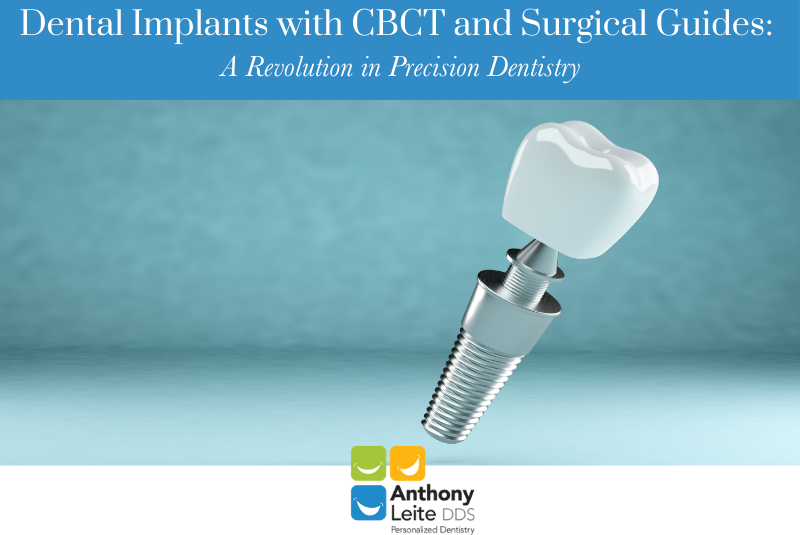
Dental implants are titanium posts that are surgically placed into the jawbone to serve as a stable foundation for replacement teeth. Unlike traditional dentures, dental implants provide a permanent solution that closely mimics the look and feel of natural teeth. They not only restore functionality but also help maintain the structure of the jawbone, preventing bone loss that often accompanies missing teeth.
The Role of CBCT in Dental Implants
Cone Beam Computed Tomography (CBCT) is a specialized imaging technology that provides detailed 3D images of the teeth, soft tissues, nerve pathways, and bone in the craniofacial region. This advanced imaging technique allows for a more accurate assessment of the patient’s dental anatomy, which is crucial for the successful placement of dental implants.
Benefits of CBCT in Dental Implants:
- Precise Assessment: CBCT offers a detailed view of the patient’s jawbone, allowing for accurate measurement of bone density, volume, and structure. This information is vital in determining the exact placement of the implant.
- Reduced Risk: By providing a comprehensive view of the anatomical structures, CBCT helps in identifying potential complications, such as proximity to nerves or sinuses, thus reducing the risk of complications during surgery.
- Customized Treatment Plan: The detailed imaging allows for the creation of a personalized treatment plan tailored to the patient’s unique dental structure, ensuring a better fit and long-lasting results.
Surgical Guides: Enhancing Precision in Implant Placement
Surgical guides are custom-made templates that assist the dentist in placing the implant at the exact location, angle, and depth determined during the planning stage. These guides are created using the data obtained from the CBCT scan, ensuring that the implant is placed with unparalleled accuracy.
Benefits of Using Surgical Guides:
- Accuracy: Surgical guides provide a roadmap for the dentist, ensuring that the implant is placed precisely where it is needed. This reduces the margin of error and increases the success rate of the procedure.
- Minimized Surgery Time: With the use of surgical guides, the procedure becomes more efficient, often reducing the time spent in surgery. This can lead to a quicker recovery and less post-operative discomfort.
- Improved Outcomes: The combination of CBCT and surgical guides significantly enhances the predictability of the outcome, leading to higher patient satisfaction and long-term success of the dental implants.
The Implant Procedure at Anthony Leite, DDS
At Anthony Leite, DDS, we follow a meticulous process to ensure the highest standard of care for our patients:
- Consultation and Evaluation: During your initial consultation, Dr. Leite will assess your oral health and discuss your goals. A CBCT scan will be performed to evaluate the condition of your jawbone and plan the implant placement.
- Treatment Planning: Using the data from the CBCT scan, a detailed treatment plan is developed. If necessary, a surgical guide is created to assist in the precise placement of the implant.
- Implant Placement: The dental implant is placed into the jawbone using the surgical guide. The procedure is performed with utmost care to ensure minimal discomfort and optimal results.
- Healing and Restoration: After the implant is placed, a healing period is required for the implant to integrate with the jawbone. Once healed, a custom crown is placed on the implant, completing your new smile.
Comprehensive Q&A Section
Q: What are the advantages of using CBCT over traditional X-rays for dental implants?
A: CBCT provides a 3D view of the jawbone, teeth, and surrounding structures, offering a more comprehensive assessment than traditional 2D X-rays. This allows for more precise planning and placement of dental implants, reducing the risk of complications.
Q: How does a surgical guide improve the success of dental implants?
A: Surgical guides are custom-made templates that ensure the implant is placed at the exact location, angle, and depth needed. This level of precision increases the success rate of the implant and leads to better long-term outcomes.
Q: Is the use of CBCT and surgical guides covered by insurance?
A: Coverage for CBCT scans and surgical guides varies depending on your insurance plan. Our office will work with you to determine your coverage and discuss any out-of-pocket costs.
Q: What is the recovery time after getting a dental implant?
A: The recovery time can vary, but most patients can expect the initial healing to take a few days to a week. Full integration of the implant with the jawbone may take several months before the final restoration is placed.
Q: Are dental implants with CBCT and surgical guides more expensive than traditional implants?
A: While the use of CBCT and surgical guides may add to the overall cost of the procedure, they significantly enhance the precision and success rate of the implant, making it a worthwhile investment in your long-term oral health.
Contact Information
If you’re considering dental implants or want to learn more about how CBCT and surgical guides can improve your treatment outcomes, contact Anthony Leite, DDS today. Our team is committed to providing the highest quality care and ensuring that your experience is as comfortable and successful as possible.
Anthony Leite, DDS
Address: 650 E Blithedale Ave #A, Mill Valley, CA 94941
Phone: (415) 388-6006
Schedule your consultation today to take the first step toward a healthier, more confident smile with advanced dental implant technology.